Categories
Time to talk treatment

Other treatment options

Ok so there are some treatment options that we haven’t covered and mostly that’s because there is not that much research behind them as possible solutions for vaginismus.

You may have seen some GINAs posting on FB threads from 2009 or in the deep dark corners of ask.com but in the interests of being open and transparent, we thought we would mention a few just so if you come across them on the interwebs you can make a more informed decision about your treatment.

As always, you should discuss your treatment options with your doctor, PFP, or gynecologist as they will be able to advise on the best treatment for you, sweet soybean! 


Acupuncture 

Acupuncture is a form of treatment that involves inserting very thin needles through a person’s skin at specific points on the body, to various depths. Some research suggests that it can help to relieve pain. There has been very little research on acupuncture as a method to treat vaginismus but speak with your doctor if you would like to learn more. 

Botox 

Botulinum neurotoxin Type A (commonly called botox) can act as a selective muscle weakening and/or paralyzing agent, to help reduce nerve pain. While the effect is reversible, botox is widely used in medicine for a variety of conditions such as painful muscle contraction, migraine, or excessive sweating. 
Some treatments involve injections of botox into the pelvic floor muscle to provide a temporary window of opportunity to rehabilitate and stretch the over-contracting pelvic floor muscles.

This is presented as an option for GINAs who have not responded to traditional treatments using dilators, pelvic floor physiotherapy, and sex therapy. Again, there is little research into this as an effective treatment method for vaginismus so speak with your doctor to explore this topic more. 


Medication 

Before we begin please note that you should speak to your doctor and PFP about pharmaceutical options to treat vaginismus and pelvic pain. GINA is no doctor (duh) so the following is just an exploration of some pharmaceutical options that have shown to be effective for some users in conjunction with vaginal dilation, PFP, and sex therapy. Again, there is little research into these options so we are a good way off a magical pill you can swallow to keep vaginismus away (ugh drainer right). 
Also important to note, stop believing everything you read on the internet! Jeez! What works for one may not work for all. 

Lidocaine Gel: Some GINAs have responded positively to Lidocaine Gel, a topical numbing gel. This is typically used to reduce pain or discomfort caused by skin irritations, scratches, or burns. It can also be used to treat rectal discomfort caused by hemorrhoids. Talk to your doctor to find out more. 

Tricyclic Medications: There are different kinds, and they are usually used to treat nerve pain. There have been some positive studies on patients with pelvic nerve pain and again, nothing substantial on vaginismus. Talk to your doctor if you want to find out more. 


Sex toys 

Hello! Got your attention there! This has been lumped in here as it’s not a treatment per se however can be a workaround for pain-free sex. There are some sex toys on the market designed to minimize the amount of penetration on the vagina and hence the pain associated with penetrative sex. Google them if you are interested in learning more. 

 

Categories
Time to talk treatment

But what about..

Pregnancy

Pregnancy is one of the wild wonders of the world, a human being grown inside of another human being. WILD. 

Now we don’t need to go into the birds and the bees here but we do need to talk about postpartum pain (pain following childbirth).

  1. Some studies show that as many as 85% of people will experience pain during their first sexual experience postpartum. 
  2. At 3 months postpartum, 45% of people reported they were still experiencing pain. 

Physical changes and hormonal changes are happening all at once, levels of estrogen and progesterone, hormones that affect sexual desire and lubrication, dramatically decrease after birth.

This can make becoming aroused or lubricated more difficult. Not to mention injuries to the pelvic floor, where the vagina or perineum (area between the genitals and anus) can tear. 


New mothers will benefit from working with a Pelvic Floor Physiotherapist (PFP) to address musculoskeletal dysfunction and postnatal pelvic strengthening.

And remember, sex therapists and mental health professionals can help too! They can address low libido, body image, postpartum depression, or other emotional factors leading to sexual pain. 


Menopause 

Following menopause and due to hormonal changes, many people will experience painful sex. Changes in estrogen levels cause tissues in the vagina and surrounding areas to become thinner and dryer.

In addition to dryness, during post-menopause sex, many people experience sexual pain, tightness, and an uncomfortable burning sensation.

Many studies show that the regular use of vaginal dilators and lubricants can be helpful to people experiencing sexual pain post-menopause, as well as seeking help from a Pelvic Floor Physiotherapist (PFP). 

Similarly, people undergoing chemotherapy for cancer will often experience symptoms of early menopause. Some chemotherapy medications irritate all mucous membranes in the body, including the lining of the vagina, which may become dry and inflamed.


Genital Reassignment Surgery (GRS)

Genital Reassignment Surgery (GRS) is a surgical procedure that changes a person’s genitalia to match that of their gender identity. During this procedure, surgeons will transform a person’s pelvic area to create a neo-vagina. This procedure is also known as vaginoplasty.

Post-operative vaginal dilation therapy is an essential part of keeping the neo-vagina functional. Vaginal dilation therapy is almost always required for life, as sexual intercourse in place of dilation may not be sufficient.


Tampons 

So we talk a lot about wanting to achieve a happy and functional pelvic floor about sex a lot here. However, the pelvic floor controls so much more than just sexual penetration.

Tampons or menstrual cups may be a difficult hurdle when suffering from vaginismus and many young people may struggle with this step during puberty and well into adulthood, and that’s ok! 

There are lots of options for dealing with menstrual bleeding apart from tampons and during your therapy, it might be better to stick to something non- penetrative like pads or period underwear until you can get a bit more comfortable with your pelvic floor and vaginal insertion.

Tampons could be something you work up to once you become comfortable with different-sized dilators.

Or you could just ditch them altogether not everyone likes using them and they may not be right for everybody. No big deal!

Categories
Time to talk treatment

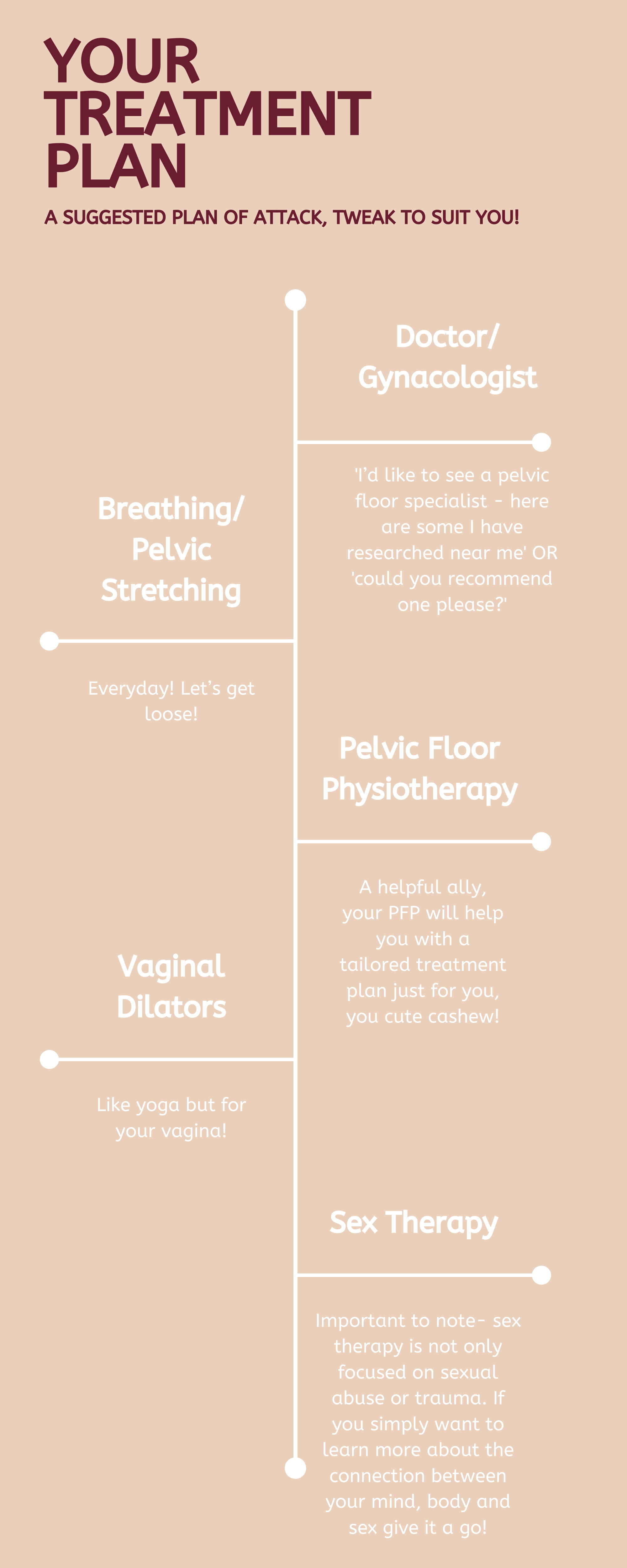
Your treatment plan